THE APPLES in stereo's "NEW MAGNETIC WONDER"


"I wrote an equation which assigns different pitches to the keys of a piano keyboard, involving a particularly fundamental function called the natural logarithm. I wondered if beautiful mathematics makes beautiful music." – Robert Schneider


THE NON-PYTHAGOREAN MUSICAL SCALE

TABLE OF CONTENTS

1. Musical Description

2. Technical Description & Graphic Comparison

3 . Scale Documentary

(20 Mb QuickTime File; Part 5 of 5; a series of recording docs by filmmaker David Gray)


4 . Non-Pythagorean Sound Font

(For use with included freeware application, in conjunction with a MIDI keyboard and to aid new composition)


5 . Sound Font Freeware Application

(For use with included Non-Pythagorean Sound Font File)


6. Exclusive "Composition #2" MP3


7. Technical ReadMe

# # #

1. MUSICAL DESCRIPTION (by Robert Schneider)

This musical readme file is dedicated to my friend Jim McIntyre (of Von Hemmling). It gives a little background about the Non-Pythagorean 12-Tone Musical Scale I invented, partially inspired by Jim's interest in modern classical music, particularly in temperament, and partially inspired by my interest in mathematics-- also it will provide you with just a few instructions to play the scale on your computer.

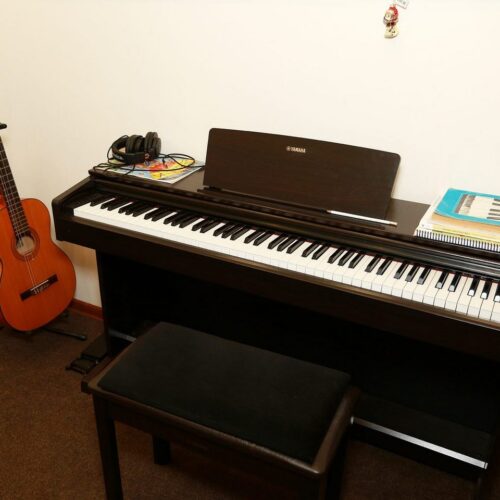
There are twelve keys in an octave on the piano keyboard, that is all the white keys and all the black keys. So a 12-tone scale means that each tone (or frequency) in the scale corresponds to one white or black key in the piano octave. The 12-tone scale included with this CD is based on the natural logarithm function, and is explained in the attached document A Non-Pythagorean Musical Scale in more detail. It is a sequence of tones which does not correspond to the notes you normally hear when you play a piano-- that is, most of the notes in this non-Pythagorean scale do not match any of the traditional pitches on the piano keyboard (I call the scale 'Non-Pythagorean' because the discovery of the traditional 12-tone scale is attributed to the Greek philosopher Pythagoras).

These are not randomly spaced pitches-- natural logarithms add together in a simple, beautiful way according to a different rule (or algebra) from the rules of addition which apply to most real numbers, and to most musical frequencies. Now musical harmonies and beat frequencies are the results of the addition and subtraction of the frequencies of tones, and largely contribute to what sounds we perceive as musical or pleasing-- and as logarithms follow a different sort of algebra of addition and subtraction, from whole numbers, I wondered if harmonies and beats resulting from this algebra would produce pleasing sensations in the listener, and if they would sound musical--

It is a little mind bending at first hearing these strange pitches come from a keyboard which formerly sounded so familiar, but the scale definitely produces chords and melodies which are musical, if alien-sounding-- the lower notes in the octave produce strong, bell-like, ringing chords and the higher notes have an almost microtonal quality which makes me feel peculiar when I play them-- in a nice way--

I have experimented with other non-Pythagorean scales, for instance one based on the square root function, but they have not produced such nice music yet-- perhaps because the mathematical relationship between the notes is not so strong-- anyway I will keep trying. I find it fascinating that you can experience these mathematical relationships with your ears-- although Pythagoras would say that experiencing mathematical relationships with your ears is what music is all about!

That the music theory of the scale is not worked out at all, I think makes it worth giving to others to experiment with, and work out.

2.TECHNICAL DESCRIPTION

A NON-PYTHAGOREAN MUSICAL SCALE By Robert Schneider

(INCLUDING A TWELVE TONE OCTAVE WHICH MAY BE ASSOCIATED WITH
TRADITIONAL MUSICAL NOTATION AND WITH THE KEYS OF A RE-TUNED PIANO)

A new musical scale is created by letting successive pitches have the ratios to one another of the natural logarithms of successive whole numbers. Most of these pitches bear no correspondence to the twelve tones generated by the circle of fifths, attributed to Pythagoras, or to the twelve tones of equal temperament tuning.

Successive notes in this scale grow closer and closer together, and the number of discrete tones in each octave increases nearly exponentially, with each successive octave.

Listening to lower octaves the ear strains to bend the tones to traditional pitches lying near them. However most of the intervals of this scale are irrational, and do not correspond to any of the traditional twelve tones. As successive tones grow closer together they become almost indistinguishable, and the resemblance to a traditional scale disappears.

To begin the scale on middle C we define a fundamental pitch K = C / 2 ln 2 = 264 Hz / 1.3863 = 190.44 Hz, where 264 Hz is a typical frequency for middle C and 1.3863 = 2 ln 2 (the notation ln M refers to the natural logarithm of M). Of course, any frequency may be substituted for C = 264 Hz in equation K to establish the scale in another key.

Then each pitch in the scale is M = K ln M (pitch M is the Mth tone).

For M=1 the first tone is silence, as ln 1 = 0. The second tone is middle C, the fourth tone is C one octave above middle C, and the sixteenth tone is two octaves above middle C. The eighth tone is G when the scale begins on C. The rest of the intervals M < 16 are not rational tones. Their ratios are irrational numbers, and they do not fall into the traditional scale or correspond to any pitches on a piano keyboard.

Successive tones grow closer together as M increases. The C an octave above M = 16 is M = 64 so there are 48 tones in that octave. The next C is M = 256 so there are 192 tones in that octave. The next octave of C is M = 1024 and so on. The construction of a piano with such a great number of keys in the higher octaves seems impossible. It is likely that the electronic medium is better suited to composing with this scale.

To create a 12-note scale suitable for playing upon a re-tuned traditional piano keyboard, and suitable for composing using traditional notation, we associate Tone 1 = K ln 4 with middle C on the keyboard.

The equation for the Nth tone in the octave above middle C is Tone N = K ln (3 + N), for N = 1 through 13.

We then associate the successive tones with successive piano keys in the octave above middle C, to Tone 12 = K ln 15. Tone 13 falls on C one octave above Tone 1 (again, K = 264 / 2 ln 2 Hz = 190.44 Hz, so that Tone 1 = 264 Hz or middle C). Higher and lower octaves of these pitches may be associated with the other octaves of the keyboard by multiplying and dividing the pitches by powers of 2.

Tone 1 = K ln 4 = 264 Hz (middle C)
Tone 2 = K ln 5 = 306.24 Hz
Tone 3 = K ln 6 = 340.56 Hz
Tone 4 = K ln 7 = 369.6 Hz
Tone 5 = K ln 8 = 396 Hz
Tone 6 = K ln 9 = 417.12 Hz
Tone 7 = K ln 10 = 438.24 Hz
Tone 8 = K ln 11 = 456.72 Hz
Tone 9 = K ln 12 = 472.56 Hz
Tone 10= K ln 13 = 488.4 Hz
Tone 11= K ln 14 = 501.6 Hz
Tone 12= K ln 15 = 514.8 Hz
Tone 13= K ln 16 = 528 Hz (C one octave above middle C)

It would be desirable to play a piano tuned to these pitches, and to hear compositions based on this sequence of tones.

The melodies and chords possible in this twelve-tone scale have a completely different nature from those produced by the traditional scale, as logarithms add according to a different algebra from whole and rational numbers, allowing for novel avenues of musical expression.

Non-Pythagorean chords have distinct "textures" resulting from beats produced by the superposition of frequencies in logarithmic intervals, which differ in feeling from chords in the traditional scale.

There is an alien beauty to the non-Pythagorean musical scale when the listener becomes accustomed to the strange intervals.

3 . Scale Documentary
(20 Mb QuickTime File; Part 5 of 5; a series of recording docs by filmmaker David Gray;
Parts 1-4 available through exclusive free Podcast from iTunes Music Store)

4 . Non-Pythagorean Sound Font
(For use with included freeware application, in conjunction with a MIDI keyboard and to aid new composition)

5 . Sound Font Freeware Application
(For use with included Non-Pythagorean Sound Font File)

6. Exclusive "Composition #2" MP3

7. Technical ReadMe

This technical readme file is dedicated to my brother-in-law Craig Morris (of The Ideal Free Distribution, and Thee American Revolution), who turned the scale which I created with a sine wave generator into a SoundFont which I could play on a MIDI keyboard. Craig also showed me how to use the MIDI keyboard.

To call this section 'technical' is a stretch. I am going to do my best to tell you how to use the included freeware to play the SoundFont (.sf2) file of the non-Pythagorean scale. Here is a link to the Wikipedia entry on SoundFonts, which is quite informative, and provides links to all of the freeware included on this CD (http://en.wikipedia.org/wiki/Soundfont).

First you should copy non-pythagorean.sf2 to an appropriate place on your hard drive, which is SoundFont that you can play on a MIDI keyboard. Then install the included programs.

MAC USERS:
Run SimpleSynth-0.8.dmg, which installs SimpleSynth, a Mac OSX freeware program which plays SoundFonts. I have never used this program as I record on a PC, so I cannot give you any help at all in using it. I'm sorry about that, but I have heard good things about this program. I would like to thank the developer Pete Yandell for allowing us to include it on this CD. Here is a link to the SimpleSynth developer?s page, which you can refer to for specs and other information: http://pete.yandell.com/software/

PC USERS:
Run sfz197.exe to install the SFZ software which will load and play SoundFont files. It is a great freeware VST plug-in, and I used it to compose the non-Pythagorean link tracks on this album. Here is a link to SFZ developer RGC Audio's page, which you can refer to for specs and other information: http://www.rgcaudio.com/sfz.htm

If you do not have a sound card or audio software which supports VST plug-ins, then you will also open chainer103.zip, and run Setup.exe to install Chainer which is an excellent standalone freeware program for using VST plug-ins. Here is a link to the Chainer developer Xlutop's page, which you can refer to for specs and other information: http://www.xlutop.com/html/chainer.html

Both Chainer and SFZ are amazing pieces of software, and I am very thankful to their developers for allowing us to include them here, and also because they have proved extremely useful to me in the studio.

Follow the installation instructions given to you by the programs and you should be on the right track. Assuming you get the programs installed successfully, I am going to tell you how to open the SoundFont.

Okay first you need to have a MIDI keyboard connected to your computer. If you don't have a MIDI keyboard you can get one easily-- MIDI basically tells the computer what notes you are playing. Mine is called 'MusicStar' and I bought it for like $30 on Ebay-- it looks exactly like a Casio with no buttons. I would recommend using a MIDI-to-USB cable (such as M-Audio's Midisport Uno) as it is plug and play, and bypasses most of the subtleties of MIDI.

If you do not have VST supporting audio software, then run Chainer.exe, and go to the System/Settings menu. Set 'ASIO Driver' to your sound card, and 'MIDI In' to your MIDI controller (for instance your USB MIDI driver). Don't worry about 'MIDI thru,' just close the window when you have checked the settings.

Then go to the first row of green windows, and press the arrow button on the far left. Open the Instruments menu and choose 'sfz.' If you do have VST supporting software, then ignore the preceding paragraph and open SFZ.

In the SFZ window, click on the gray window to the right of 'FILE' and open non-pythagorean.sf2 from the location where you saved it on your hard drive.

You should be able to play the scale on your MIDI keyboard now. If not, consult a friend who knows more than you do, like my brother-in-law Craig.

Explore the strange tones and chords. You have never heard these tones in these combinations before. Maybe nobody has.

Sincerely,
Robert Schneider
The Apples in stereo