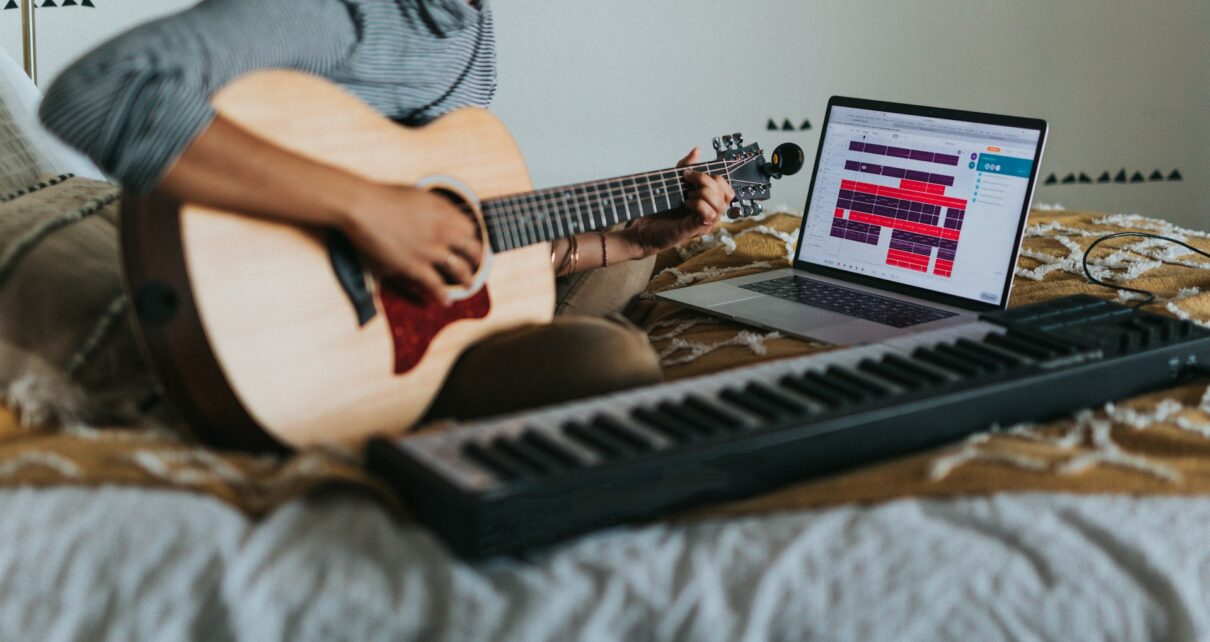
Neither guitar nor piano is objectively easier to learn. That answer frustrates people who want a shortcut, but it’s the only honest one. The instrument that’s easier for you depends entirely on what you want to do with it — and the two instruments have completely different learning curves that favor different types of learners at different stages.
Here’s what the first year actually looks like on each, and how to decide which one fits your situation.
The First Month — Where Each Instrument Wins
The piano has one clear advantage at the very beginning: the layout makes physical sense. Notes go from left to right in a linear sequence, and every key produces a clean sound the moment you press it. There’s no finger calluses to build, no finger placement to calibrate — you sit down, press a key, and hear a note. A beginner can play a recognizable melody on their first day.
Guitar is harder to start. The first two to four weeks involve building calluses on your fingertip, training your fretting hand to press strings cleanly against frets, and developing enough left-hand strength to hold chord shapes without buzzing. A C major chord on guitar requires three fingers placed precisely on three different strings at three different frets. Most beginners take several weeks before that chord sounds clean.
Much like beginners research instruments before deciding what to learn, online gaming fans also tend to compare platforms carefully before registering, and detailed information about bonuses, gameplay features, and user experience can be found in this review of Malina Casino https://gry-hazardowe-zadarmo.com/malina-casino/, helping players understand what the platform offers before getting started.
The physical discomfort is real and temporary — but it’s a barrier that piano simply doesn’t have. If your only goal is to play something recognizable as fast as possible, piano wins the first month.
The First Year — Where It Gets More Complicated
After the initial weeks, the two instruments diverge sharply in how they reward practice and what skills they build. Three areas matter most.
Reading Music and Theory
Piano teaches music theory visually. The keyboard is a direct map of Western harmony — you can see intervals, scales, and chord structures laid out in front of you. Learning to read sheet music on piano translates directly to understanding how music works. This makes piano the stronger foundation if you’re serious about music education, composition, or ever want to understand what you’re playing rather than just playing it.
Guitar beginners rarely start with sheet music. Most learn through chord charts and tablature — a notation system that shows where to put your fingers rather than what notes you’re playing. Tab is fast to learn and gets beginners playing songs quickly, but it doesn’t build music theory understanding. Many guitarists who learned through tabs for years can’t read standard notation and have limited understanding of why chord progressions work the way they do.
Playing Songs You Actually Want to Play
This is where guitar has a decisive advantage. Most popular music — rock, folk, country, indie, singer-songwriter — is built on guitar chord progressions that are learnable within three to six months. Four chords cover hundreds of songs. A beginner guitarist who learns G, C, D, and Em can strum along to a genuinely impressive catalog by the end of their first year.
Piano repertoire for beginners is more limited in terms of songs that sound satisfying to play. Classical beginner pieces are technically accessible but don’t scratch the itch for someone who wants to play music they hear on the radio. Pop piano arrangements exist, but many require two-hand coordination that takes longer to develop than basic guitar chord strumming.
Portability and Practice
A guitar goes anywhere. Acoustic guitars require no amplification, no power source, and fit in the back of a car. Practice happens wherever you have fifteen minutes. This matters more than most people admit — an instrument you can pick up spontaneously gets practiced more often than one that requires sitting down at a dedicated piece of furniture.
Piano requires either owning a piano or a digital keyboard, a power source, and usually a fixed location. A decent digital keyboard with weighted keys costs $300–600 minimum for an instrument that actually simulates the feel of a real piano. An acoustic entry-level guitar costs $150–200 and is playable out of the box.
How to Decide Based on Your Actual Goals
No learning curve comparison matters if the instrument doesn’t connect to the music you actually want to play. Here’s a direct breakdown by situation.
Choose Piano If
You want to understand music theory deeply, you’re interested in classical music or jazz, you want a foundation that makes learning other instruments easier, or you’re helping a child under twelve build musical literacy. Piano is the more complete musical education — it teaches you how music works, not just how to play it.
Choose Guitar If
You want to play songs you love within six months, you’re drawn to rock, folk, acoustic pop, or singer-songwriter music, you need an instrument that fits a mobile lifestyle, or you’re an adult starting from zero who needs early wins to stay motivated. Guitar gets you to the campfire moment — playing recognizable music for yourself or others — faster than any other instrument.
The Question Worth Asking
Most people who ask “guitar or piano” are really asking “which one will I actually stick with.” That answer comes from knowing what you want to play, not from which instrument has a shorter learning curve. Pick the one that connects to the music you already love, and the early difficulty — on either instrument — becomes something you’re motivated to push through rather than a reason to quit.